


Replacing a Failing Cedar Shake Roof: Why Mountain Homeowners Are Switching to Composite
One of our clients described the moment he knew his roof was done: the cedar shakes were splintering and landing on the ground around his house. At 8,400 feet, his roof had spent years swinging between deep cold under heavy snow and warm, bone-dry days. Eventually the wood just gave out.
We see this every season. From May to October, a big share of our crews’ work is replacing cedar shake roofs that have reached the end of their life. And most of those homeowners are choosing a composite shake that keeps the look of cedar without the problems that come with it.
Here’s how to tell when your cedar roof is done, what Colorado’s wildfire code now means for your re-roof, and what to know before you switch.

Why Cedar Shake Wears Out Faster Up Here
Cedar is a beautiful roof, and when it was made from old-growth wood, it could last a long time. Mountain conditions are brutal on it, though. Intense high-altitude UV dries it out. Freeze-thaw cycles pry at every crack. Snow sits on it for months, then the spring melt soaks it, then the summer bakes it. Over time, shakes cup, curl, split, and thin out, and moss or rot can move in where water lingers.
Signs your cedar shake roof needs replacing:
- Pieces of shake splitting, splintering, or showing up on the ground
- Curling, cupping, or shakes that have thinned and gone brittle
- Missing shakes, or gaps where you can see underlayment
- Moss, soft spots, or rot, especially on shaded slopes and in valleys
- Leaks that show up during spring melt
One or two of these doesn’t automatically mean a new roof. Sometimes a targeted [repair] buys you real time, and we’ll tell you straight if that’s the case. But when the whole field is failing, patching becomes a losing game.

The Fire Question: Colorado’s WUI Code
Wildfire risk used to be a reason to consider a different roof. Now, in a lot of places, it’s a code requirement.
Colorado’s statewide Wildland-Urban Interface (WUI) code took effect July 1, 2025. In designated WUI zones, a roof replacement that covers more than 25% of the roof generally has to use Class A roofing, along with ember-resistant vents and non-combustible gutters. Designated zones include parts of Avon-Edwards and Basalt-Carbondale, so this touches both of our valleys.
That makes your roofing material a code question, not just a style question. Before we bid a re-roof, we confirm whether your property sits in a WUI zone, so you aren’t surprised halfway through permitting.
We still install real cedar where it makes sense and the code allows. But for most mountain homes today, composite is the better fit.
What “Class A” really means
Here’s a detail a lot of people miss: a Class A fire rating typically applies to the roof assembly, not just the tile. The composite shake, the underlayment beneath it, and how it’s installed all work together to earn that rating.
My business partner Jake Borah put it simply when our 2023 DaVinci Project of the Year was recognized. That homeowner, high on Beaver Creek Mountain, had cedar shake, and the goal was to move to a synthetic product and achieve a Class A assembly.
Here’s Jake’s 2023 Project of the Year video:

What Changes When You Switch From Cedar to Composite?
The look stays. Good composite shake is molded from real wood profiles and comes in blends that mimic natural cedar color variation. From the street, most people can’t tell. Up close, the good products still hold up.
Maintenance drops. No rot, no insects, no splitting shakes to replace every spring. That’s the biggest reason our clients make the switch.
The ratings go up. DaVinci, the composite we install most, rates its products Class A for fire and Class 4 for impact, and backs its residential roofs with a lifetime limited materials warranty. Fire and impact ratings can also help with insurance premiums. Ask your insurer.
Snow behaves differently. This is the one that surprises people. Cedar absorbs water, and the snowpack freezes to it. Composite doesn’t absorb anything, so snow slides. If you switch, plan [snow retention] as part of the new roof. I explain how we lay out [snow guards] in a separate post.
Two cedar-to-composite projects
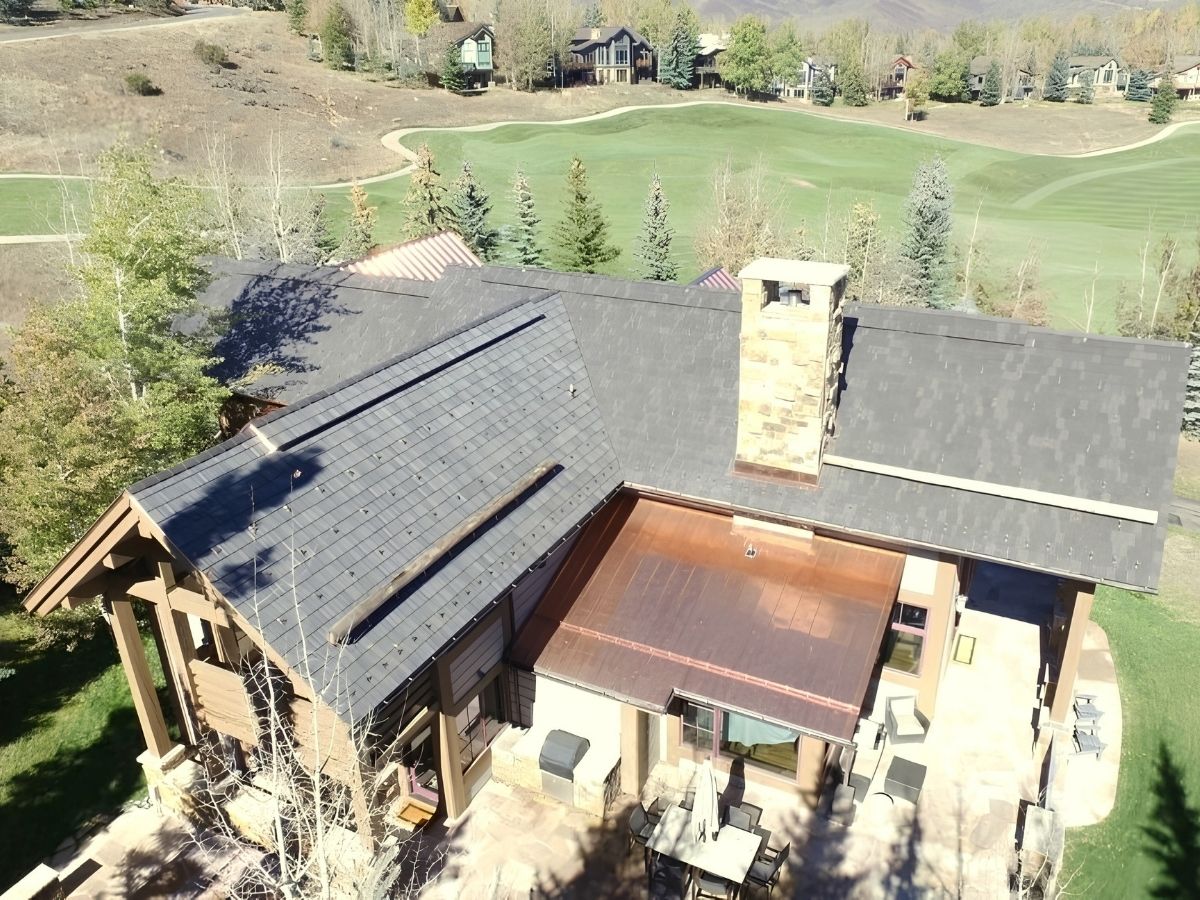
A home at 8,400 feet. The homeowner’s cedar was splintering and falling around the house. We evaluated the roof, agreed it had reached the point of replacement, and walked the owners through several options. We recommended DaVinci composite shake for its looks, ease of installation, fire resistance, warranty, and color options, and that’s what they chose. In a WUI area, the fire resistance mattered most.
Our 2023 Project of the Year on Beaver Creek Mountain. A custom home high on the mountain, previously roofed in cedar, now in DaVinci with a Class A assembly. It earned DaVinci’s Project of the Year recognition for Masterpiece contractors.
How to choose the right composite shake
Composite shake comes in a few styles, from uniform single-width tiles to multi-width and rougher, hand-split profiles. Here’s how I help homeowners narrow it down:
- Match the house. A timber-frame mountain home often looks best with a thicker, multi-width profile. A cleaner contemporary design may suit a more uniform tile.
- Look at samples in real light. Colors read differently in high-altitude sun than in a showroom. We bring samples to the site.
- Check your HOA first. Many mountain HOAs now require or prefer synthetic products, but most have approved profiles and colors. Get that list before you fall in love with a blend.
- Consider metal too. For some roofs, standing seam metal is the better answer. The right choice depends on your pitch, snow load, and style.
If you’re a board weighing options for multiple buildings, my post on how Buckhorn’s association compared products on total cost of ownership is worth a read, and we work with a lot of HOAs on exactly this decision.
Cedar Shake Replacement FAQs
Q: Is composite shake Class A fire rated?
A: Quality composite shake can achieve a Class A fire rating as part of a rated roof assembly, which includes the right underlayment and installation. Ask your roofer exactly which assembly they’re installing.
Q: How long does a composite shake roof last?
A: Manufacturers design top-tier composite shake to last many decades, and DaVinci backs its residential roofs with a lifetime limited materials warranty. Installation quality matters just as much, so ask about the contractor’s workmanship warranty too.
Q: Does composite shake look fake?
A: Cheap products can. The better ones are molded from real cedar and blended in varied colors. We’re happy to show you finished roofs in your area so you can judge for yourself.
Q: Will my HOA approve composite shake?
A: In many mountain communities, yes. Some now require synthetic roofing. Check your design guidelines for approved products and colors before you choose.
Q: Do I need snow guards if I switch from cedar?
A: Usually, yes. Composite sheds snow that cedar used to hold, so plan snow retention as part of the re-roof.
Is your cedar roof telling you it’s time?
Call our Eagle office at 970.704.9130 or learn more about our roof replacement process. We’ll look at your roof, tell you honestly whether it needs replacing, check your WUI status, and walk you through the options that make sense for your home. And if you’re still getting bids, here are the questions to ask a roofer first.
As featured in
Westlake Royal Building Products, “Fast Fix: Replace Failing Real Cedar Shakes with Composite Shakes”:
DaVinci Roofscapes, 2023 Project of the Year video interview with Jake Borah
