

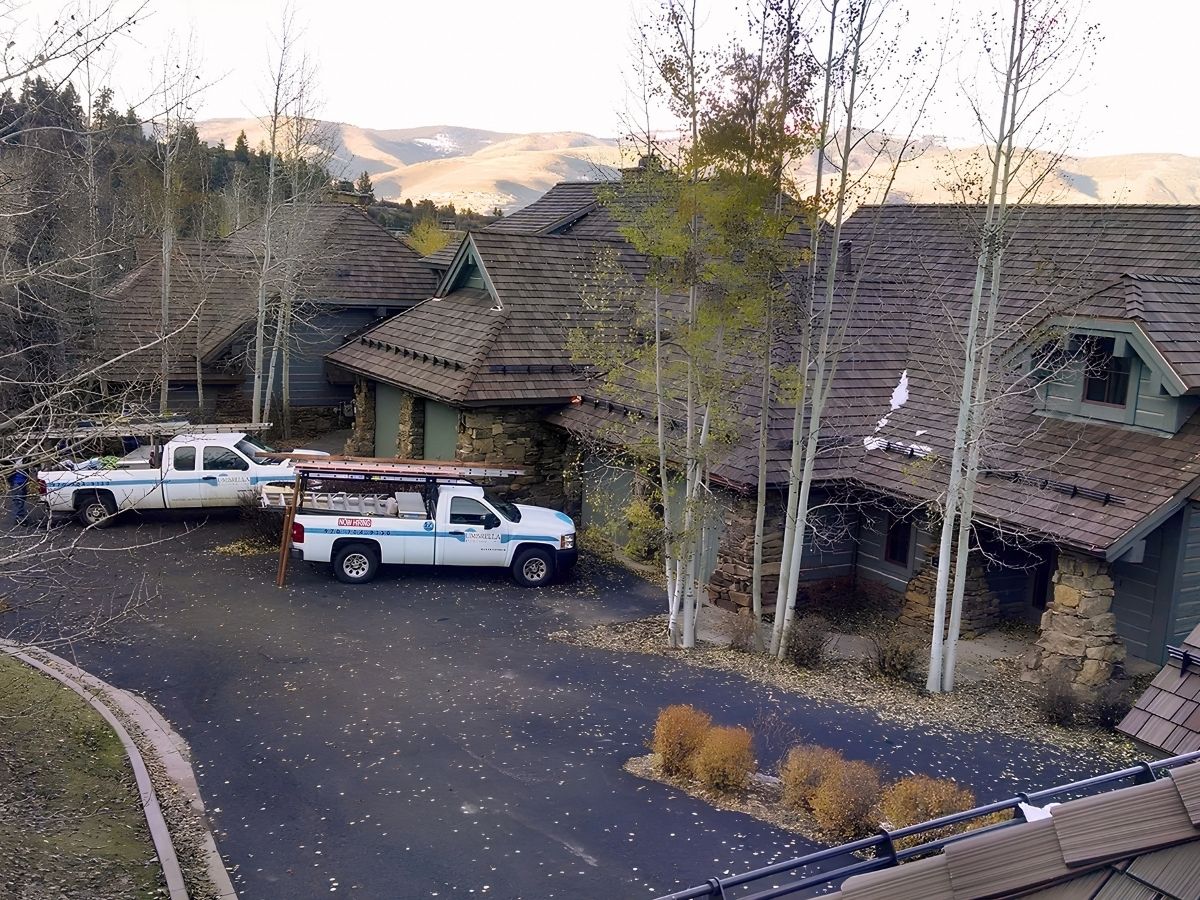

Buckhorn at Bachelor Gulch: The HOA Re-Roof That Built Our Vail Valley Team
In 2013, Trevor, Umbrella’s founder, sat my business partner Jake Borah and me down and asked a question we still talk about: “Are you ready to burn the bridge?”
A big HOA re-roof had come up at Buckhorn Townhomes in Bachelor Gulch, and Trevor saw it as the start of something bigger. If Umbrella was going to build a real presence in the Vail Valley, Jake and I had to commit completely. No one foot in, one foot out.
We said yes. With Umbrella behind us, we rented a 1,200-square-foot garage and went to work. Buckhorn was the project that launched our Vail Valley operation. It also taught us most of what we know about roofing for HOAs and condo associations. Here’s what that job looked like, and the lessons we’d pass on to any board planning an HOA roof replacement.
The project: two dozen townhomes in a resort within a resort
Bachelor Gulch is the high-end village between Beaver Creek and Arrowhead, and it has a strict HOA and design review board that protects the look and feel of the neighborhood. Buckhorn is a community of two dozen ski-in, ski-out townhomes there.
Over the course of the project, we installed more than 77,000 square feet of DaVinci Multi-Width Shake in the Autumn blend, along with custom flat-seam copper roofs. The roofs were steep and cut up, with a lot of transitions between the copper and the composite shake. We worked in phases, starting in August 2013 and wrapping up in October 2014.
Before a single tile went on, we spent months planning with the HOA, including multiple site visits and a full snow retention design with Rocky Mountain Snow Guards.
How the association chose the roof
The Buckhorn owners wanted the look of natural cedar shake, without cedar’s fire risk, maintenance, pest problems, and freeze-thaw wear. Their management company, OAC Management, didn’t just collect bids and pick the lowest one. They ran a comparative analysis and a cash model: listing every product’s attributes, evaluating the manufacturers, comparing costs, and seeing which option came out on top over the life of the roof.
DaVinci Multi-Width Shake won on appearance, warranty, testing, certifications, and how it holds up in mountain weather. As a contractor, that’s the kind of process I love to see, because the board ends up with a decision it can explain and defend to every owner.

7 Lessons for Any HOA Roof Replacement
1. Compare total cost of ownership, not just bids. The cheapest roof today is rarely the cheapest roof over 30 years. A comparative analysis like OAC’s looks at lifespan, maintenance, warranty, and insurance, and it gives your board a paper trail owners can understand.
2. Build the design review timeline into the plan. In communities like Bachelor Gulch, approvals take time. Start early, and work with a roofer who knows how to put together a clean submittal with product samples and details.
3. Phase the work around owners and the season. Our roofing season up here runs roughly May through October. On a multi-building project, phasing lets you spread the work (and the cost) across seasons, keep some units undisturbed, and avoid racing the first snow.
4. Treat snow retention as part of the roof. When an association moves from cedar to composite or metal, snow that used to stick starts to slide, often over shared entries, walkways, and parking. Design snow retention into the re-roof from day one. On our larger HOA projects, we lay out snow guards in [soldier rows] engineered for the building’s snow load.
5. Sweat the transitions. On Buckhorn, the hardest details weren’t the big shake fields. They were where the copper met the composite. Transitions, valleys, and flashing are where roofs leak. Having our own sheet metal shop let us build those details in-house instead of hoping a sub got them right.
6. Plan communication with owners, not just the board. Many mountain HOA owners are out of state or rent their units. Ask your contractor how they’ll handle notices, schedules, access, and questions, and who the single point of contact will be.
7. Ask for proof at scale. Plenty of roofers can do one house. Ask for multi-building projects you can visit. A few of ours in Edwards: at Alpine Club, we installed 1,750 snow guards in soldier rows on a DaVinci shake roof, and at One Arrowhead Place, 2,400 snow guards plus a snow fence at the eave.
If your board is just starting the process, my list of questions to ask a roofer is a good place to begin.

What the Buckhorn Roofing Project Built
That garage didn’t stay a garage for long. Over the next five years, Jake and I grew Umbrella’s Vail Valley operation into a full second market. Eventually we bought that side of the company, and Deric Barton, who had been working out of Umbrella’s Pitkin County office, joined us as a partner. In December 2025, the three of us bought the remaining Roaring Fork Valley market from Trevor, bringing both sides of Umbrella back together under one ownership.
A lot of the crew members who worked on Buckhorn are still with us. That’s the part I’m proudest of.
For HOA boards and property managers
Whether you’re planning a full replacement or just trying to get ahead of your reserve study, we can help. We work with property management companies and HOA boards across the Vail and Roaring Fork Valleys, and every bid we submit is itemized and board-ready, with license and insurance documentation included so you can compare it line by line. Learn more about our HOA roofing services or call our Eagle office at 970.704.9130.
As featured in
Rocky Mountain Snow Guards, “Buckhorn Townhomes in Bachelor Gulch, CO uses Rocky Mountain Snow Guards”
DaVinci Roofscapes, “Colorado Townhome Community Topped with DaVinci Roofscapes Polymer Shake Tiles”:
RoofersCoffeeShop, “Solving the mountain roofing challenge” (September 2026):
