

Blog Title
For a long time, most roofs in the Vail Valley held their snow all winter. Cedar shake soaks up water, the snowpack freezes to it, and it usually doesn’t let go until spring, when the melt works its way down from the ridge to the eave.
Then the roofs changed. Wildfire risk, maintenance costs, and HOA requirements have moved a lot of homes and associations from cedar to synthetic shake, synthetic slate, and metal. Those are better roofs in almost every way. But they absorb zero water, and snow doesn’t grip them the way it gripped cedar.
So now we see roofs that held their snow for decades suddenly dropping it in sheets onto decks, walkways, and cars. That’s why snow retention is part of nearly every re-roof we do. And it’s why how you lay out snow guards matters just as much as whether you install them.

Why a new roof sheds snow the old one held
A slick roof surface plus a heavy snowpack plus a warm afternoon is a recipe for a roof avalanche. Composite shake and slate don’t give the snow anything to hold onto, so as it starts to melt underneath, the whole pack can release at once. Metal is even faster.
That snow has to land somewhere. On a mountain home it’s usually a deck, an entry, a driveway, or a hot tub. On a condo building it’s a shared walkway or a parking lot. Snow guards give the snowpack something to grab so it stays put and melts off gradually, instead of coming down all at once.
What a soldier row pattern is
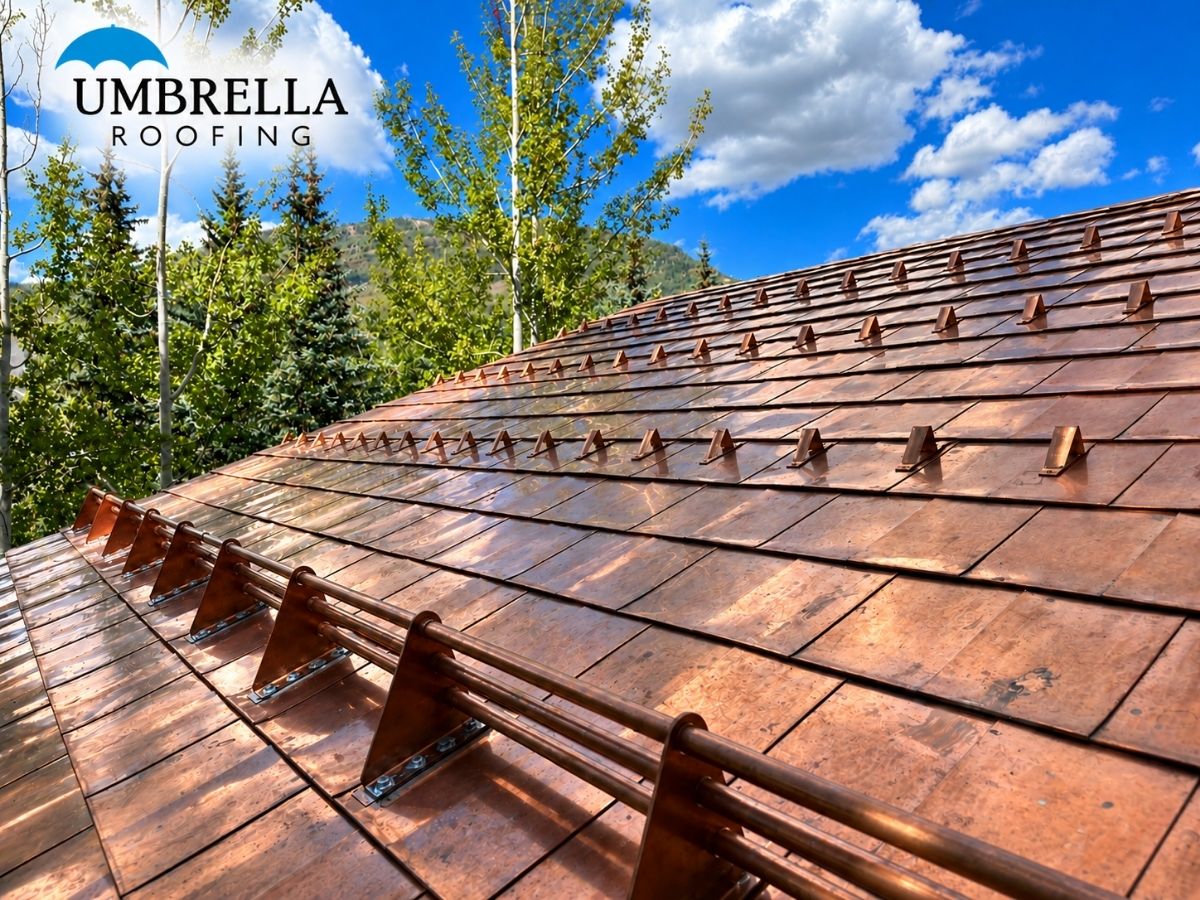
A soldier row is a straight horizontal line of snow guards set tight together, about one every 12 inches, running across the roof plane. The rows repeat up the slope.
The older approach is a spread pattern: guards scattered across the whole roof on a staggered grid, something like one every three feet across and every few rows up. It works, but it relies on each guard adding a little friction.
The team at Rocky Mountain Snow Guards has studied this. Their finding is that guards spaced 12 inches on center behave more like a continuous barrier than a set of individual friction points. As long as that tight spacing holds within each row, the rows themselves can often sit farther apart up the roof than people expect, depending on pitch and snow load.
How far apart should snow guards be?
There are really two measurements.
- Across the row: about 12 inches on center in a soldier row pattern.
- Between rows: it depends on your roof. Pitch, the ground snow load at your elevation, the roofing material, and what sits below the eave all change the answer.
That second number is why we don’t work from a template. On our projects, we send the roof plans to Rocky Mountain Snow Guards and their design team builds a custom layout around the snow load for that specific home. We install to that design. After as many of these as we’ve done, we could probably eyeball most roofs. We still engineer every one, because the homeowner deserves more than a guess.
EDITOR NOTE FOR LIZ: confirm with Josh that an engineered RMSG layout is still standard practice on every job, not just larger projects.
We also install guards across the whole roof, not just over the front door. When you only protect one spot, the snow around it still moves, and shedding gets less predictable, not more.
How many snow guards do I need?
Honestly, nobody can answer that without a layout. The count comes out of the design: square footage, number of roof planes, pitch, and snow load. Anyone quoting you a snow guard count over the phone is guessing.
For a sense of scale, here are two HOA projects we did in Edwards. At Alpine Club, we installed 1,750 RG16 snow guards in soldier rows on a DaVinci Multi-Width Shake roof. At One Arrowhead Place, it took 2,400 RG16 guards plus a NoFlash III snow fence at the eave. Big, cut-up roofs over busy walkways need a lot of holding power.
Why I prefer the soldier row pattern
It creates a more even melt-off. When the snow is held evenly across the whole roof, there’s less chance for sections to slide down into pinch points: the bottoms of dormers, along sidewalls, the bottoms of valleys. Snow that stays spread out melts more consistently. That lets your gutters and heat cable keep up as things warm up, instead of getting buried by a big load lower on the roof. It won’t eliminate ice dams, nothing does on its own, but it cuts the problem down. If ice is already a headache at your place, our page on [heat cable and ice dam prevention] covers the other half of that equation.
It looks better. A soldier row reads as clean, deliberate lines. A spread pattern can make a roof look busy. With the right layout, snow guards add to the finished roof instead of distracting from it, which matters on homes where the roof is a big part of the architecture.
The bids are more accurate. Working from an engineered layout, I can count exactly what a roof needs instead of estimating from averages. That means fewer surprises for the homeowner.
My crews install it faster and more consistently. They aren’t constantly snapping chalk lines and stopping to check a staggered grid. One guard every foot becomes a natural rhythm, and the install is cleaner for it.
Metal and copper roofs: clamp, don’t drill
On standing seam metal and copper, we use clamp-to-seam snow fences whenever we can. They attach directly to the seams, so there are no holes through the panels. That matters because metal panels expand and contract every day with the temperature swings we get up here. Screw through a panel and you restrict that movement, and over time that can cause problems. A well-installed standing seam roof is about as watertight as a sloped roof gets, and the snow retention shouldn’t compromise it. I get into this more in our post on [copper roofs].

What we’re installing now
We’ve relied on Rocky Guard RG16 snow guards for years. Lately we’ve also been running the Everest EG16 from Rocky Mountain Snow Guards, first on a composite slate project and then on a composite shake project. The EG16 holds just as well as the RG16, but it’s designed to stack, so it takes up a lot less room on the truck and is easier to handle on the roof. It comes powder-coated in dark bronze, black, or harbor gray, so it can match or disappear into the roof.
An award-winning example in Arrowhead
In 2025, our dark bronze RG16 soldier rows on a DaVinci Select Shake roof in Arrowhead earned a Runner Up prize in Rocky Mountain Snow Guards’ national Show Us Our Snow Guards contest. It’s what we call a cut-up roof: lots of planes, valleys, and transitions, which is exactly where a thoughtful layout earns its keep.
Listen: I talked through this project and the soldier row pattern with Karen Edwards on RoofersCoffeeShop’s Roofing Road Trips podcast, alongside Brian Cross of Rocky Mountain Snow Guards.
For HOAs, condo associations, and property managers
On a shared building, sliding snow isn’t just a maintenance issue. It’s a safety and liability issue over entries, walkways, and parking. If your association is moving from cedar to synthetic or metal, budget snow retention as part of the re-roof, not as an add-on after the first slide. We work with a lot of HOAs and condo associations and property managers across the valley, and planning retention up front is always cheaper and cleaner than retrofitting later.
Snow Guard FAQs
Q: How far apart should snow guards be?
A: In a soldier row pattern, about 12 inches on center across each row. The spacing between rows depends on roof pitch, snow load at your elevation, and roofing material, so it should come from an engineered layout for your roof.
Q: Do snow guards need to go all the way up the roof?
A: On most mountain roofs, yes. Holding the snow evenly across the whole roof keeps sections from sliding into pinch points and gives you a more even melt. Protecting only one spot tends to make shedding less predictable.
Q:Do cedar shake roofs need snow guards?
A: Cedar holds snow better than most roofing because it absorbs water and the snowpack freezes to it. The need usually shows up when you replace cedar with synthetic shake, synthetic slate, or metal. If you’re planning that switch, plan snow retention with it.
Q: Can snow guards be added to an existing roof?
A: Often, yes. On standing seam metal, clamp-to-seam systems can go on without penetrating the panels. On shingle-style roofs like composite shake and slate, guards fasten beneath the courses, so a retrofit takes careful work to do right.
Q: When should snow guards be installed?
A: Ideally during a re-roof or before winter. If your roof is already dropping snow this season, call us now. We can look at it, get a layout designed, and schedule the install for the first workable window.
Q: Seeing snow come off a roof that never used to shed?
A: That’s usually the first sign a roof needs a retention plan. Call our Eagle office at 970.704.9130, or learn more about our snow guards and snow retention systems. We’re local, we’re here all winter, and we’ll tell you straight whether your roof needs it.
As featured in:
Western Roofing Magazine, “Soldiering On” (September 2025)
AskARoofer, “Soldier Rows of snow guards help with snow retention” (May 2025)
Architectural West, “Specifying Everest Snow Guards” (November 2025)
RoofersCoffeeShop, Roofing Road Trips: “Soldier Row Pattern Shines” (October 2025)
